

J Studios
As we roll toward the fall season in the States, it brings back football, back-to-school season, and images of fall foliage. Regardless of the season, however, there are upcoming dividend increases! This week features twelve new increases, mainly comprised of smaller financial institutions. The group has an average increase of 7.6% and a median increase of 6.4%. Let’s roll on and see if there are any interesting ideas here.
My investment strategy involves buying, holding, and adding to companies that meet two criteria: consistently increasing their dividends and beating an equivalent benchmark. The information in this article is generated for my investing needs, and I’m happy to share my findings with my Seeking Alpha audience. This list can help you make wise investment choices and create a successful long-term portfolio.
How I Created The Lists
The following information is a result of merging two sources of data: the “U.S. Dividend Champions” spreadsheet from a particular website and upcoming dividend data from NASDAQ. This process combines data on companies with a consistent dividend growth history with future dividend payments. It’s important to understand that all companies included in this list have consistently grown their dividends for at least five years.
Companies must have higher total yearly dividends to be included in this list. Therefore, a company may not increase its dividend every calendar year, but the total annual dividend can still grow.
What Is The Ex-Dividend Date?
The ex-dividend date is when you must own shares to qualify for an upcoming dividend or distribution. To be eligible, you must have bought the shares by the end of the preceding business day. For instance, if the ex-dividend date is Tuesday, you must have acquired the shares by the market close on Monday. If the ex-dividend date falls on a Monday (or a Tuesday following a holiday on Monday), you must have purchased the shares by the previous Friday.
Dividend Streak Categories
Here are the definitions of the streak categories, as I’ll use them throughout the piece.
- King: 50+ years.
- Champion/Aristocrat: 25+ years.
- Contender: 10–24 years.
- Challenger: 5+ years.
| Category | Count |
| King | 0 |
| Champion | 3 |
| Contender | 4 |
| Challenger | 5 |
The Dividend Increases List
The data is sorted by the ex-dividend date (ascending) and then by the streak (descending):
| Name | Ticker | Streak | Forward Yield | Ex-Div Date | Increase Percent | Streak Category |
| Capital City Bank Group | (CCBG) | 11 | 2.7 | 9-Sep-24 | 9.52% | Contender |
| Victory Capital Holdings, Inc. | (VCTR) | 5 | 3.1 | 10-Sep-24 | 10.81% | Challenger |
| Avnet, Inc. | (AVT) | 11 | 2.53 | 11-Sep-24 | 6.45% | Contender |
| Winnebago Industries, Inc. | (WGO) | 7 | 2.31 | 11-Sep-24 | 9.68% | Challenger |
| Broadridge Financial Solutions, Inc. | (BR) | 17 | 1.66 | 12-Sep-24 | 10.00% | Contender |
| Community Trust Bancorp, Inc. | (CTBI) | 44 | 3.82 | 13-Sep-24 | 2.17% | Champion |
| Community Financial System, Inc. | (CBU) | 32 | 3.06 | 13-Sep-24 | 2.22% | Champion |
| Albemarle Corporation | (ALB) | 30 | 1.94 | 13-Sep-24 | 1.25% | Champion |
| Worthington Enterprises, Inc. Common Shares | (WOR) | 10 | 1.57 | 13-Sep-24 | 6.25% | Contender |
| Capital Southwest Corporation | (CSWC) | 9 | 10.17 | 13-Sep-24 | 1.59% | Challenger |
| Silvercrest Asset Management Group Inc. | (SAMG) | 7 | 5.14 | 13-Sep-24 | 5.26% | Challenger |
| Devon Energy Corporation | (DVN) | 7 | 2.09 | 13-Sep-24 | 25.70% | Challenger |
Field Definitions
Streak: Years of dividend growth history are sourced from the U.S. Dividend Champions spreadsheet.
Forward Yield: The payout rate is calculated by dividing the new payout rate by the current share price.
Ex-Dividend Date: This is the date you need to own the stock.
Increase Percent: The percent increase.
Streak Category: This is the company’s overall dividend history classification.
Show Me The Money
Here is a table that shows the new and old rates and the percentage increase. The table is sorted by ex-dividend day in ascending order and dividend streak in descending order.
| Ticker | Old Rate | New Rate | Increase Percent |
| CCBG | 0.21 | 0.23 | 9.52% |
| VCTR | 0.37 | 0.41 | 10.81% |
| AVT | 0.31 | 0.33 | 6.45% |
| WGO | 0.31 | 0.34 | 9.68% |
| BR | 0.8 | 0.88 | 10.00% |
| CTBI | 0.46 | 0.47 | 2.17% |
| CBU | 0.45 | 0.46 | 2.22% |
| ALB | 0.4 | 0.41 | 1.25% |
| WOR | 0.16 | 0.17 | 6.25% |
| CSWC | 0.63 | 0.64 | 1.59% |
| SAMG | 0.19 | 0.2 | 5.26% |
| DVN | 0.35 | 0.44 | 25.70% |
Additional Metrics
Some different metrics related to these companies include yearly pricing action and the P/E ratio. The table is sorted the same way as the table above.
| Ticker | Current Price | 52 Week Low | 52 Week High | PE Ratio | % Off Low | % Off High |
| CCBG | 34.09 | 25.37 | 36.49 | 13.05 | 34% Off Low | 7% Off High |
| VCTR | 52.91 | 27.93 | 55.16 | 7.55 | 89% Off Low | 4% Off High |
| AVT | 52.17 | 41.87 | 55.8 | 0 | 25% Off Low | 6% Off High |
| WGO | 58.86 | 49.68 | 74.35 | 31.55 | 18% Off Low | 21% Off High |
| BR | 211.48 | 164.71 | 223.81 | 36.19 | 28% Off Low | 6% Off High |
| CTBI | 49.2 | 32.39 | 52.22 | 10.54 | 52% Off Low | 6% Off High |
| CBU | 60.09 | 34.37 | 63.95 | 21.24 | 74% Off Low | 6% Off High |
| ALB | 84.67 | 71.97 | 186.95 | 39.11 | 17% Off Low | 55% Off High |
| WOR | 43.4 | 35.9 | 69.75 | 4.18 | 21% Off Low | 38% Off High |
| CSWC | 25.16 | 19.19 | 27.23 | 0 | 31% Off Low | 8% Off High |
| SAMG | 15.57 | 13.76 | 18.45 | 11.47 | 14% Off Low | 15% Off High |
| DVN | 42.18 | 39.79 | 54.67 | 0 | 6% Off Low | 23% Off High |
Tickers By Yield And Growth Rates
I’ve arranged the table in descending order so that investors can prioritize the current yield. As a bonus, the table also features some historical dividend growth rates. Moreover, I have incorporated the “Chowder Rule,” which is the sum of the current yield and the five-year dividend growth rate.
| Ticker | Yield | 1 Yr DG | 3 Yr DG | 5 Yr DG | 10 Yr DG | Chowder Rule |
| SAMG | 5.14 | 5.6 | 5.9 | 5.6 | 7.8 | 10.7 |
| CTBI | 3.82 | 4.6 | 6.1 | 5 | 4.7 | 8.8 |
| VCTR | 3.1 | 18 | 58.2 | |||
| CBU | 3.06 | 2.3 | 2.3 | 3.4 | 4.9 | 6.4 |
| CCBG | 2.7 | 17.2 | 11.6 | 15.4 | 35.3 | 17.8 |
| AVT | 2.53 | 6.9 | 13.4 | 9.2 | 7.5 | 11.7 |
| WGO | 2.31 | 14.8 | 37.2 | 23.6 | 25.9 | |
| DVN | 2.09 | 10.5 | 15.2 | 20.6 | -0.7 | 22.7 |
| ALB | 1.94 | 0.6 | 1.1 | 2.6 | 4.5 | 4.6 |
| BR | 1.66 | 10.4 | 11.6 | 10.5 | 14.3 | 12.2 |
| WOR | 1.57 | -22.6 | -2.3 | 0.9 | 4.8 | 2.5 |
| CSWC | 10.17 | 8.6 | 10.8 | 9.1 | 27.5 | 19.3 |
Historical Returns
My investment approach involves identifying stocks consistently outperforming the market while increasing dividend payouts. I use the Schwab U.S. Dividend Equity ETF (SCHD) as a benchmark to gauge performance. I use the “Cohen & Steers REIT & Preferred Income Fund” (RNP) for REITs. I prefer to invest in an ETF if a stock cannot outperform its benchmark. SCHD has a strong track record of exceptional performance, offers a higher yield than the S&P 500, and has consistently grown dividends. I’ve added many companies to my own portfolio based on this analysis (and further due diligence). I’ll also make timely purchases of existing holdings as well.
The ten-year dividend growth rate is one of the four main factors in the index behind SCHD. It’s an important factor in total return performance. Share prices follow strong dividend growth over long periods, and longer trends will drown out short-term movements. These are total return figures, which include reinvested dividends.
The chart contains SCHD plus the nine companies with the highest 10-year dividend growth rates.
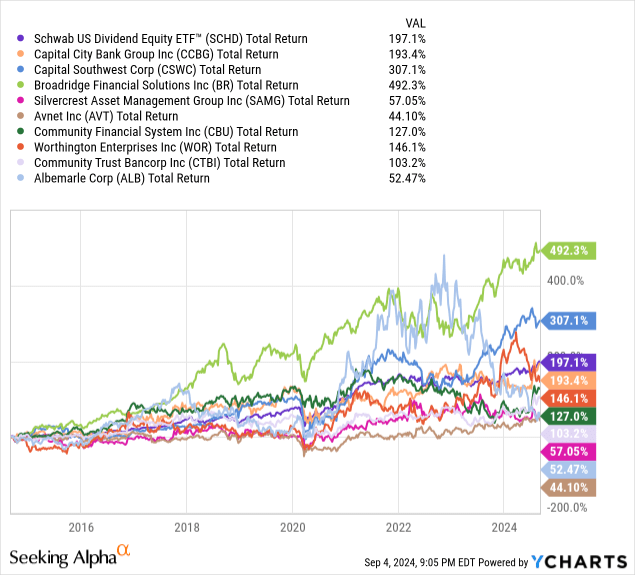
This week features a few interesting stories. SCHD (in purple) provided investors with a 197% total return over the past decade. Only two companies managed to top it: BR at 492% and CSWC at 307%. I’ll give a small shout out to CCBG for a “market perform” in comparison with SCHD.
Everyone else lagged to a particular degree! Three companies, SAMG, ALB, and AVT, only offered a range of 44-57% total return over a decade! Not only that, but ALB had a tremendous fall from grace after spiking at 400% total returns by late 2022.
Next Steps
As an investor, I have high standards for the individual holdings in my portfolio. It’s not just about beating a certain benchmark by a small margin; I look for companies with a proven track record of exceptional past performance. I want to analyze their historical data meticulously to assess the likelihood of such performance continuing.
This week I am very interested in learning more about BR and to a lesser extent, CSWC. The story with BR that caught my eye immediately was the strong performer over the entire time. This wasn’t a flash in the pan stock or had a fall from grace or any other short-term narrative that could be spun. Returning to their dividend history, they tend to offer low double-digit growth year in and out.
I’ll also take a look at CSWC and learn more about its business and opportunities there as well. Their performance is great, though not nearly as consistently stellar as BR’s. They also offer strong dividend growth potential over the periods listed. Not knowing more about them, they also have a 10% current yield.
Let me know what you think of my strategy, and feel free to add yours in the comments below! As always, please do your due diligence before making any investment decision.
link